Hydrostatic pressure
Online calculator — enter the values and get the result instantly, with the formula and a worked example.
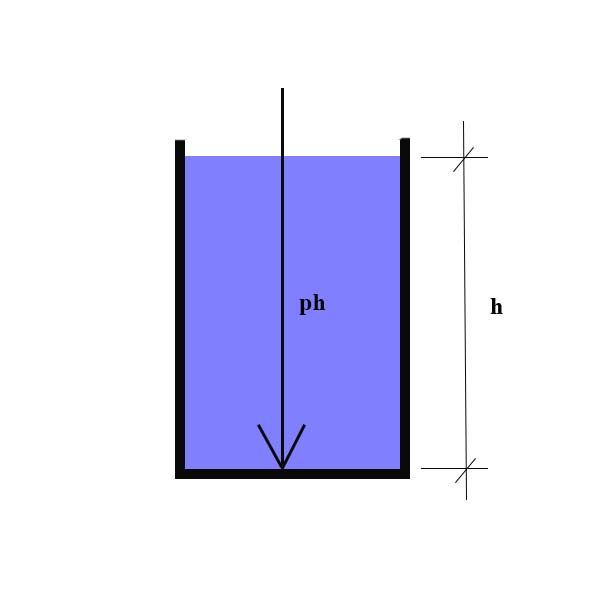
p = ρ · g · h
p = hydrostatic pressure (Pa)
ρ = fluid density (kg/m3)
g = gravitational acceleration (9.81 N/kg)
h = depth below the surface (m)
Hydrostatic pressure is the pressure that arises in a liquid at rest through the action of its own weight. Every layer of the liquid presses with its mass on the layers below it, and so the pressure grows with the depth below the surface. It depends only on the depth, on the density of the liquid and on the gravitational acceleration — not at all on the shape of the vessel or on how much liquid it holds. That is exactly why the pressure at the same depth is the same in a narrow tube as in a wide lake, which is known as the hydrostatic paradox.
At a given point the pressure acts equally in all directions, and the atmospheric pressure above the surface is added on top of the pressure of the liquid. Hydrostatic pressure is around us at every step: it is why dams have thicker walls at the bottom, why divers have to equalise the pressure in their ears, and why water towers are built high so that the mains have enough pressure. The same principle is used by hydraulic equipment and by simple mercury and liquid pressure gauges.
Hydrostatic pressure
–
Drag across the graph — the pressure at that depth
Solve it step by step — the next step unlocks only after a correct answer. You can type decimals with a dot or a comma.
